Mitsubishi AC Not Cooling in Pasadena
The short answer: When a Mitsubishi mini-split stops cooling in Pasadena, the top causes are a flare-joint leak (U7), a frozen coil from a dirty filter, or an outdoor MUZ unit that will not start (U6). Call (213) 444-4051 or book online and Pasadena Mitsubishi HVAC reads the code and tests under load across the 91101 to 91107 ZIPs.
Fast facts
- Top no-cool causes here: low refrigerant, frozen coil, capacitor/inverter fault, drain backup.
- Check yourself first: clean the filter, confirm the breaker, set the remote to cool well below room temp.
- Codes that matter: U7 (low charge), U6 (inverter/compressor), P5 (drain), P6 (freeze protection).
- Service area: Pasadena 91101, 91103, 91104, 91105, 91106, 91107.
- No-cool calls triaged first in cooling season.
What should I check before calling?
Two minutes of checks can save a service call during Pasadena's hottest weeks. Pull the indoor filter and rinse it - a choked filter is the number one cause of a mini-split that quietly stops cooling and ices its coil. Confirm the breaker and the outdoor disconnect are on. Set the remote to cool, with the setpoint a good 5 degrees below the room temperature, and check that an MHK2 thermostat or kumo cloud schedule is not holding it in a different mode. If a head iced over, switch it off and let it thaw before restarting.
What is the fault code telling me?
Pull the code from the wireless remote, MHK2, or kumo cloud and match it here. This narrows the repair before we arrive.
| Code / symptom | Likely cause / first check | Typical lane |
|---|---|---|
| U7, weak cooling, frost | Low refrigerant from a flare-joint leak | $225 - $1,500 |
| U6, outdoor unit will not run | Inverter PCB or compressor; measure board | $400 - $2,000+ |
| No code, hums, will not start | Run/start capacitor or contactor | $150 - $450 |
| P5, water under head, no cool | Drain backup tripping protection | $150 - $450 |
| P6, ices then quits | Dirty filter/coil restricting airflow | $89 - $350 |
How a tech diagnoses a no-cool call, in order
A no-cool diagnosis follows the refrigerant and the airflow, not guesswork. Here is the order we work it on a Mitsubishi mini-split:
- Read the fault history off the indoor board LED, MHK2, or kumo cloud and note the exact P, U, or E code before touching anything.
- Confirm the basics: power at the disconnect, the indoor filter and coil clear, the remote set to cool well below room temperature, and the outdoor coil not choked with debris.
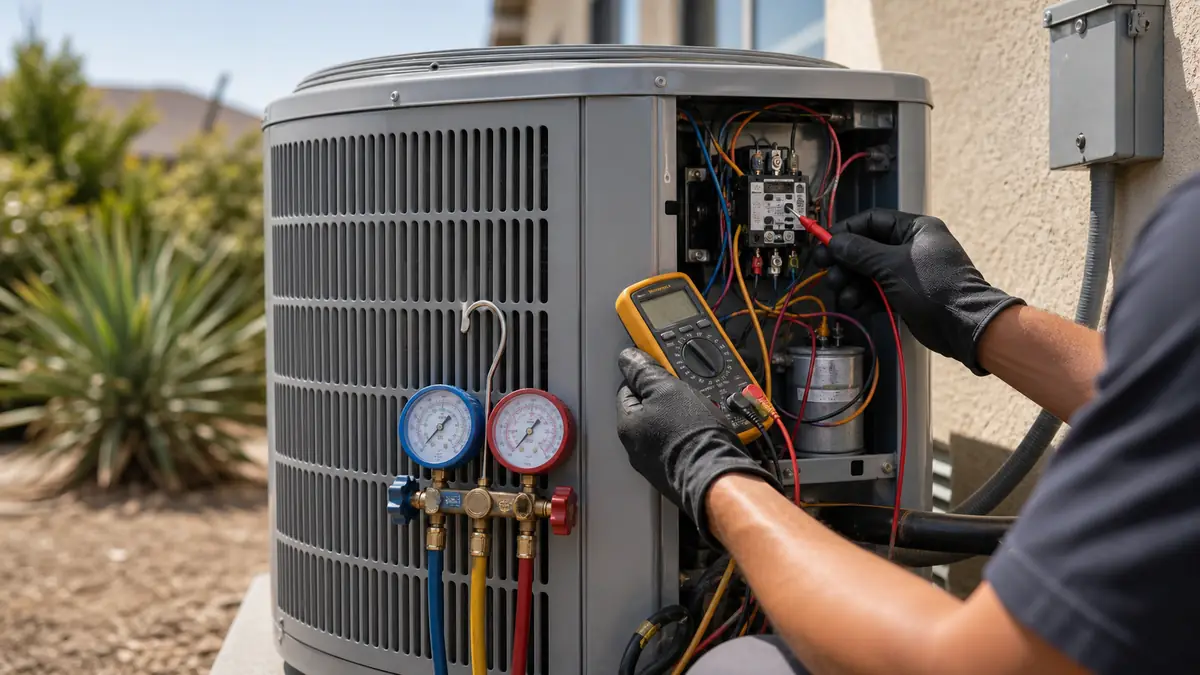
- At the outdoor MUZ, check the run/start capacitor with a meter and the contactor for pitting; a swollen cap or a unit that only hums points here.
- Gauge the refrigerant circuit and read superheat and subcool. Low discharge superheat or a U7 with frost on the line set points to a leak, usually at a flare joint, not a unit that simply needs a top-off.
- If the board itself is suspect on a U6, measure the inverter PCB and IPM output and the DC compressor windings before condemning the most expensive part.
What is safe to check myself, and what needs a pro?
Safe homeowner steps: rinse the indoor filter, gently clear leaves and debris off the outdoor coil with the power off, confirm the breaker and disconnect, and let a frozen head thaw fully before restarting. Stop there. Opening the outdoor cabinet exposes a charged capacitor that holds a dangerous jolt even with the breaker off, and any work on the sealed refrigerant circuit requires EPA certification and recovery equipment. A U6, a U7 with frost, or a head that ices the moment you restart it is a pro call.
What will the fix cost?
It depends entirely on which fault it is. A run/start capacitor or contactor on the outdoor MUZ is typically $150 to $450, mostly trip and labor since the part is cheap. A flare-joint leak repair plus recharge runs $225 to $1,500 depending on how much R-410A the circuit lost and how buried the joint is. An inverter PCB replacement lands $400 to $2,000-plus. A dead inverter compressor on an older unit is $1,200 to $3,500 - the point where the repair-or-replace math usually decides it. We quote the part before we open the cabinet.
Why does Pasadena heat expose these faults?
A marginal capacitor or a slightly low charge can hide all winter and most of spring. Then a Zone 9 foothill afternoon hits 92 F, the system runs flat-out against the heat-island load near the San Gabriel range, head pressure climbs, and the weak part finally gives up. That is why we test under load - a unit that cools fine at 8 a.m. can fail at 3 p.m. We bring the system to its working condition before condemning a part.
What if it is the compressor?
If the diagnosis lands on a dead inverter compressor in an older MUZ, the fix can creep toward half what a replacement runs. We spell out both figures using the repair-or-replace guide. For the full repair process see AC repair in Pasadena; if the unit cools but cycles oddly, read short cycling.
Common questions
Why is my Mitsubishi blowing air but not cold air?
If the fan runs but the air is not cold, the compressor is either not running or not pumping refrigerant. The usual Pasadena causes are a low charge from a flare-joint leak (U7), an outdoor unit that will not start on a capacitor or inverter fault (U6), or a frozen coil from restricted airflow. Check the filter first, then call (213) 444-4051.
Can a dirty filter really stop my mini-split from cooling?
Yes. A clogged filter or dirty indoor coil chokes airflow, the coil ices over, and cooling collapses, sometimes throwing a P6 protection code. Pull the filter and rinse it. If the head iced up, shut it off and let it thaw before restarting. If it ices again right away, the problem is deeper and we should look.
It cools fine in the morning but quits in the Pasadena afternoon heat. Why?
A system that fails only in peak heat is usually low on refrigerant or has a weak capacitor that cannot carry the compressor under the added load of a 95 F-plus foothill afternoon. The extra head pressure exposes a marginal part. We test under load rather than in the cool morning when the fault hides.
How fast can you come out for a no-cool call?
We triage no-cool calls ahead of routine work in cooling season, and during a Santa Ana heat spike past 100 F we run the after-hours line. Same-week scheduling is normal across 91101 to 91107. Tell us your model and any code on the remote when you call (213) 444-4051.