No Heat from Your System in Pasadena
The short answer: No heat in Pasadena usually means a heat pump pausing for a normal defrost cycle, a low refrigerant charge (U7 or P8), or a gas-furnace ignition lockout. Call (213) 444-4051 or book online and Pasadena Mitsubishi HVAC reads the fault on Mitsubishi inverter units and the LED or numeric code on Trane and Carrier furnaces across the 91101 to 91107 ZIPs.
Fast facts
- Heat-pump no-heat: defrost cycle (normal), low charge U7/P8, stuck reversing valve, LEV fault.
- Furnace no-heat: igniter, flame sensor, pressure switch, or high-limit lockout (read the LED/code).
- Check yourself: thermostat set to Heat above room temp, breaker on, filter clean.
- Service area: Pasadena 91101, 91103, 91104, 91105, 91106, 91107.
- We service all brands; Mitsubishi is our specialty.
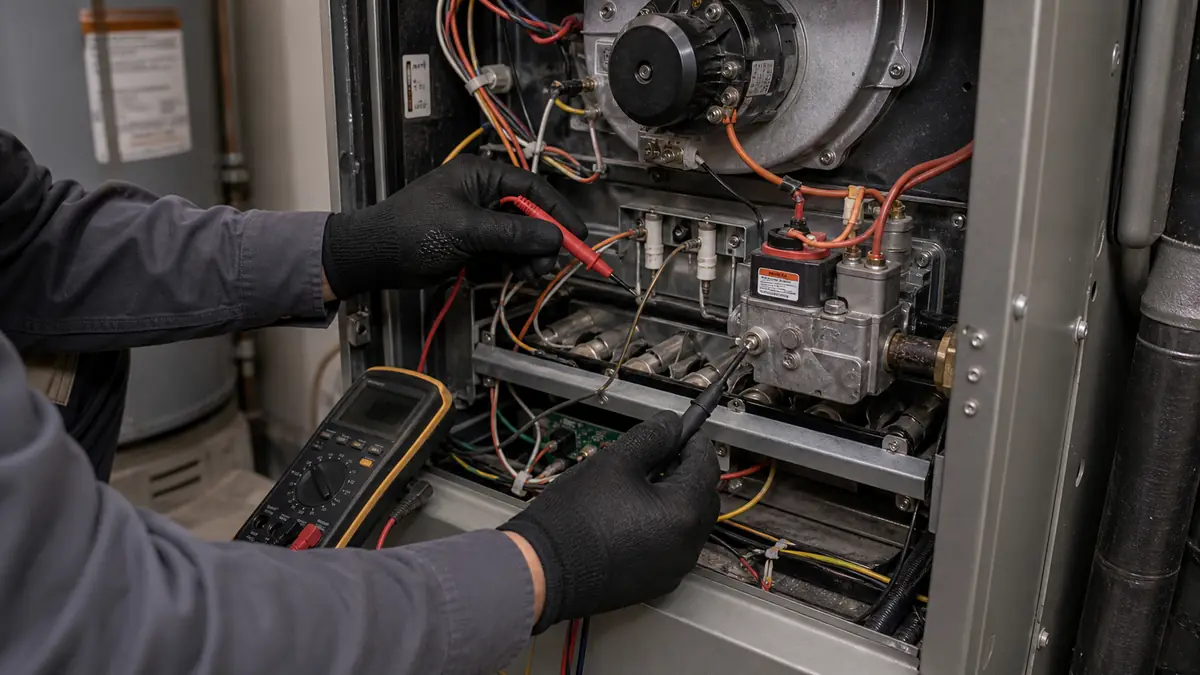
Heat pump or furnace? They fail differently
Most Pasadena homes we serve heat with a Mitsubishi heat pump, but plenty still run a gas furnace from Trane or Carrier, sometimes paired with a Mitsubishi cooling system. The no-heat diagnosis splits cleanly by equipment.
Mitsubishi heat pump
A heat pump that blows cool for a few minutes is often just running a defrost cycle to clear frost off the outdoor coil - that is normal on a cool foothill morning. Real no-heat faults are low refrigerant from a flare leak (U7, P8), a sticking LEV electronic expansion valve, a drifted thermistor, or an inverter fault that stops the compressor (U6, U9).
Gas furnace
A furnace announces its failure with a blinking LED. The common no-heat causes are a worn hot-surface igniter, a dirty flame sensor that drops out the burner, a pressure-switch fault on the inducer, or a high-limit trip from restricted airflow. Trane flashes patterns like 4 flashes for an open high-limit; Carrier shows two-digit codes such as 14 for an ignition lockout or 31 for a pressure-switch fault.
Reading the code
The fault tells you whether you are looking at a normal heat-pump defrost, a refrigerant or electronic fault on a Mitsubishi inverter, or a furnace ignition lockout. Pull the Mitsubishi code off the remote, MHK2, or kumo cloud, or count the furnace control-board LED flashes (Trane patterns, Carrier two-digit codes), then match it to the lane below before we arrive.
| Code / symptom | Likely cause / first check | Typical lane |
|---|---|---|
| Heat pump cool for minutes, recovers | Normal defrost cycle; no repair needed | $0 |
| Heat pump weak heat, U7/P8 | Low refrigerant; pressure test and reseal | $225 - $1,500 |
| Furnace clicks, no light | Igniter or flame sensor | $200 - $600 |
| Furnace short lockout, pressure code | Pressure switch or inducer motor | $250 - $700 |
| Furnace runs then trips, high-limit | Restricted airflow; dirty filter or blower | $150 - $800 |
How we diagnose a no-heat call, in order
The first job is deciding whether the system is actually broken or just doing something normal, then following the fault to its part.
- Confirm the thermostat is set to Heat and several degrees above room temperature, the breaker is on, and the filter is clean - this clears a surprising share of calls.
- On a heat pump, watch one full cycle: a few minutes of cool air with the outdoor unit running and steaming is a normal defrost, not a fault. If it never recovers, read the Mitsubishi code (U7, P8, U6, U9) and gauge the refrigerant circuit and reversing valve.
- On a gas furnace, read the control-board LED flash count. We watch the ignition sequence: inducer, pressure switch closing, igniter glow, gas valve open, flame proven on the sensor - and the step that fails names the part.
- Measure the suspect component directly - microamps on the flame sensor, resistance on the hot-surface igniter, continuity on the pressure and high-limit switches - before replacing it.
What is safe to check myself, and what needs a pro?
Safe homeowner steps: set the thermostat correctly, replace a dirty filter, reset the breaker once, and let a heat pump finish a defrost cycle before deciding it has failed. Anything past that on a gas furnace - the igniter, gas valve, pressure switch, or a rollout trip that may signal a cracked heat exchanger - is a pro call, because it involves combustion and gas. A rollout or repeated limit lockout in particular should never be repeatedly reset; it is a safety device doing its job.
What will the fix cost?
On a heat pump, a low-charge flare-leak repair and recharge runs $225 to $1,500, and a stuck reversing valve or inverter fault climbs from there. On a gas furnace, an igniter or flame sensor is commonly $200 to $600, a pressure switch or inducer motor $250 to $700, and an airflow-driven high-limit trip often just a $150 to $800 cleaning or blower fix. If a no-heat fault keeps recurring on an aging unit, the repair-or-replace guide shows when a replacement, or an all-electric Hyper-Heat swap, makes more sense than another part.
What we do next
For a heat pump, see heat pump repair in Pasadena. If the no-heat keeps recurring on an old unit, weigh a replacement with the repair-or-replace guide, and consider an all-electric Hyper-Heat swap if you are tired of the gas furnace entirely. If the system also struggles to cool, read AC not cooling.
Common questions
My Mitsubishi heat pump blows cold air on a cold Pasadena morning. Is it broken?
Not necessarily. When the outdoor coil frosts on a cool foothill morning, the unit briefly runs a defrost cycle and pauses heating, which feels like cold air for a few minutes. If it never recovers and keeps blowing cool, that points to low refrigerant, a stuck reversing valve, or an LEV fault, and we should test it. Call (213) 444-4051.
My furnace clicks but will not light. What is the code?
On a gas furnace, no-light with repeated clicking is usually the ignition train: a weak hot-surface igniter, a dirty flame sensor, or a pressure-switch or limit trip. The control board flashes a code (for example, a Trane LED pattern or a Carrier two-digit code) that names the failed part. Read the flashes and call so we bring the right part.
Why does my heat pump heat weakly but never quit?
Steady but weak heat usually means the system is low on refrigerant from a flare-joint leak (often U7 or P8) or the LEV expansion valve is sticking. The compressor runs, but it cannot move enough heat. We pressure-test the circuit and check superheat rather than just topping off refrigerant that will leak right back out.
Is no-heat an emergency in mild Pasadena?
Rarely life-threatening given Pasadena's mild winters, but an uncomfortable house with kids or elderly residents still gets prompt scheduling. We book no-heat calls quickly, especially during a cold snap, across the 91101 to 91107 ZIPs. Call (213) 444-4051 or book online.