Mitsubishi AC & Mini-Split Repair in Pasadena
The short answer: Pasadena Mitsubishi HVAC repairs Mitsubishi Electric mini-splits and AC across Pasadena, from Bungalow Heaven (91104) to Hastings Ranch (91107), reading M-Series fault codes, clearing P5 drain faults, fixing flare-joint leaks, and testing inverter boards before quoting. Most fixes land between $89 and $1,500; call (213) 444-4051 or book online.
Fast facts
- Service area: Pasadena plus Bungalow Heaven, Madison Heights, Historic Highlands, Linda Vista (91101, 91103, 91104, 91105, 91106, 91107).
- Units serviced: MSZ-FS, MSZ-GL, MSZ-FX, MSZ-WR wall heads; MUZ outdoor condensers; MXZ multi-zone.
- Diagnostic: $89 - $200 (often near $139), credited toward the repair.
- Capacitor / contactor: $150 - $450. Refrigerant leak repair: $225 - $1,500. Inverter PCB: $400 - $2,000.
- Same-week service in cooling season; no-cool calls triaged first. Independent shop.
What goes wrong with Mitsubishi AC in Pasadena?
Pasadena sits in Title-24 Climate Zone 9 on the San Gabriel foothill floor, where the mountains trap heat and afternoon highs sit around 88 to 92 F for 25 to 40 days a year, with Santa Ana spikes over 100 F. That is a cooling-dominant load, and it is hard on the outdoor side of a Mitsubishi system. The single most common no-cool cause we see is low refrigerant from a leaking flare joint, followed by condensate drain failures inside the house and inverter or capacitor faults on the condenser.
Because so many Pasadena homes are ductless retrofits, the indoor units are MSZ wall heads tucked into plaster-walled rooms with drain lines that were never sloped well. When a P5 (drain pump) or P4 (drain sensor) code shows and water beads under the head, we start at the pan, pump, and float, not the refrigerant circuit.
Reading the fault code first
Mitsubishi inverter systems log a letter-plus-number code you can pull off the wireless remote, the MHK2 thermostat, or the kumo cloud app. That code narrows the job before we open a panel:
- P4 / P5 / P6 - drain sensor, drain pump, or freeze/overheat protection. Usually airflow or condensate, not refrigerant.
- U7 - low discharge superheat, the classic low-refrigerant signature pointing to a flare-joint leak.
- P8 - abnormal pipe temperature, a second leak tell we settle with a pressure test.
- U6 - the MUZ board reporting compressor overcurrent or an inverter (IPM) fault.
- U2 / U3 - high discharge temperature or discharge thermistor, often tied to low charge or a dirty coil.
- E6 / E7 / EA / EB - inter-unit S1/S2/S3 communication faults, frequently a loose or corroded terminal.
How does a Mitsubishi AC repair actually go?
On a Pasadena no-cool call we work a deliberate sequence, because in this old plaster-walled housing the cheap fault and the expensive one wear the same symptom, and the only way the price reflects what actually broke is to chase the evidence in order. The first stop is the wireless remote or the kumo cloud app, where the MSZ logs its fault history; we read that, then prove the code with instruments before a single panel comes off.
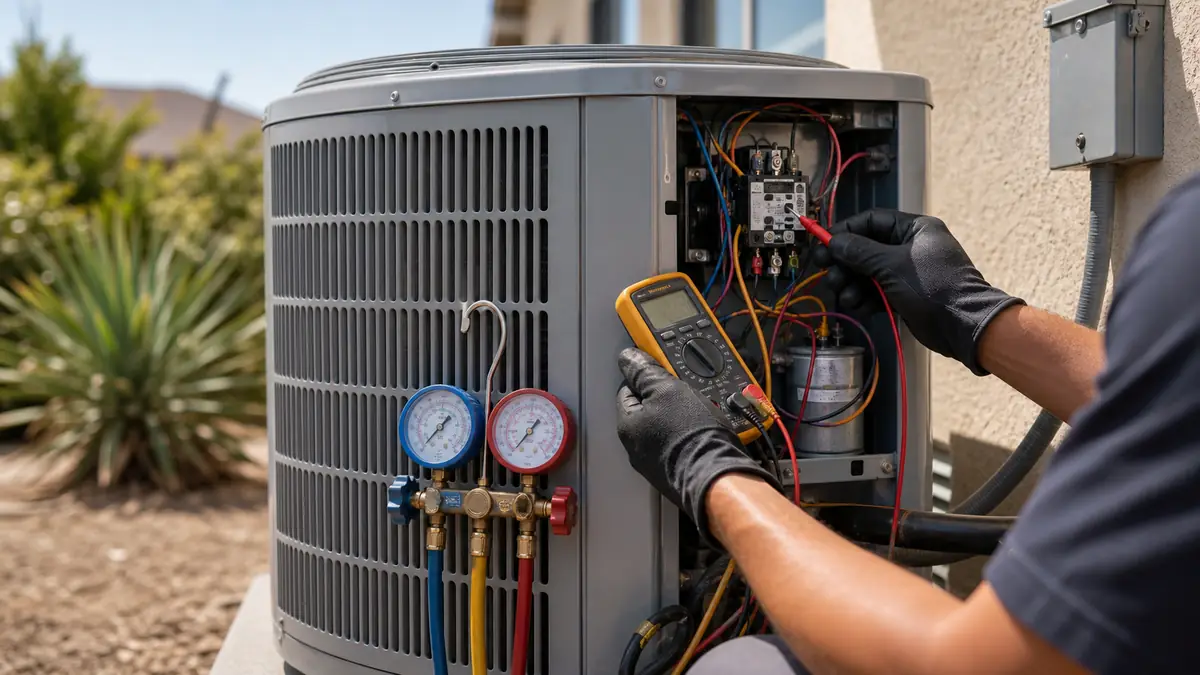
- Read and confirm the code. Each code points somewhere specific: a P5 puts us at the drain pump and float, a U7 or P8 routes us to the refrigerant side, and a U6 lands us on the MUZ inverter board. Then the meters confirm it: a clamp meter clamped on the compressor and capacitor leads, manifold gauges reading superheat and subcooling off the line set, and a multimeter walked across the S1/S2/S3 terminals where the indoor head talks to the condenser.
- Pin down the actual part. A suspected leak gets a dry-nitrogen pressure test until the flare or coil joint gives itself up; a head that cools weakly means measuring LEV/EEV expansion-valve travel and ohming the TH1/TH2/TH5 thermistors against Mitsubishi's resistance tables; a dead MUZ means reading the run capacitor's microfarads and watching whether the contactor actually pulls in.
- Quote before opening. You get a written price on the exact component - capacitor, contactor, drain pump, expansion valve, thermistor, or inverter PCB - so there is no surprise.
- Fix it, then prove it held. If we opened the refrigerant circuit we recharge by weight and re-read superheat; we make sure the condensate actually runs off and the float drops back to ready; and we leave the head running a complete cooling cycle to be sure the fault log comes up empty before we pack the truck.
Which Mitsubishi models do you repair?
Which family the unit belongs to shifts the job, since an indoor head and an outdoor condenser break down along different lines. We cover the whole M-Series plus the heavier P-Series you find on bigger Pasadena homes:
- MSZ wall heads (MSZ-WR, MSZ-GL, MSZ-FS with the 3D i-see sensor, MSZ-FX H2i plus) - mostly condensate, choked filter/coil airflow, thermistor, and i-see sensor trouble, which is squarely P-code work.
- MUZ single-zone condensers (MUZ-WR, MUZ-HM, MUZ-FS, MUZ-FX) - the capacitor, contactor, DC fan motor, inverter PCB, and compressor live here, so this is where the U-codes show up.
- MXZ / MXZ-SM multi-zone (MXZ-3C, MXZ-SM36/42/48) - a single weak room usually traces to a branch LEV or a leaking line set, whereas every zone going dark together accuses the shared outdoor unit.
- MFZ floor consoles and MLZ ceiling cassettes - they speak the same fault codes as the wall heads, just with their own drain paths to keep an eye on.
- SVZ / MVZ / SEZ ducted air handlers and P-Series PEAD/PVA - an ECM blower motor joins the list of things that can fail, and the newer single-zone ducted P-Series is charged with R-454B, which we recover and refill to that spec.
What will a Pasadena AC repair cost?
What you pay follows the part that died, not the symptom you noticed. These are the lanes we quote most often in Pasadena - dated typical 2026 SoCal ranges, every one confirmed on-site before a wrench turns.
| Symptom | Likely cause / first check | Typical lane |
|---|---|---|
| Water under indoor head, P4/P5 | Clogged drain or failed drain pump; clear line, test float | $150 - $450 |
| Weak cooling, frost on coil, U7 | Flare-joint refrigerant leak; pressure test and reseal/recharge | $225 - $1,500 |
| MUZ buzzes on the pad but never spins up | Failed run/start capacitor, or a contactor not pulling in | $150 - $450 |
| Airflow weak, P6 protection | Dirty filter or coil restricting airflow; clean, check static | $89 - $350 |
| U6, outdoor unit trips on startup | Inverter PCB or compressor; measure board first | $400 - $2,000+ |
| Comfort drift, P1/P2/P9 | Intake, liquid-pipe, or coil thermistor (or i-see sensor) | $150 - $500 |
| E6/EA/EB comm error, intermittent shutdowns | Loose or corroded S1/S2/S3 inter-unit wiring | $89 - $400 |
| Outdoor fan dead, U8 | Outdoor DC fan motor replacement | $450 - $1,200 |
What it costs in Pasadena, broken down
Two things drive the number: the part itself and the access. The diagnostic runs $89 to $200 (commonly near $139) and is credited when you proceed. From there the sub-jobs stack up like this:
- Electrical parts (capacitor, contactor) - the part is $10 to $45; the $150 to $450 is mostly the trip and labor.
- Refrigerant leak repair - leak search is $100 to $330, then R-410A runs roughly $50 to $80 per pound installed; a flare reseal is cheap, a coil leak is not.
- Inverter PCB - the board by itself frequently lands between $120 and $800-plus, and that price tag is the whole reason a U6 on an aging MUZ turns into a repair-or-replace conversation instead of a no-brainer fix.
- Access surcharge - a head mounted high on a two-story Historic Highlands wall or a condenser tucked into a tight side yard adds labor a ground-floor unit does not.
If the math tips toward replacement, read our repair-or-replace guide for Pasadena before committing.
What is different about repairs in Pasadena's old housing?
The city's pre-war stock changes how these jobs run. In Bungalow Heaven and Historic Highlands, retrofit drain lines were often fished through plaster-and-lath walls with too little slope, so condensate backs up and throws P4 and P5 codes far more here than in a modern tract home. Flare joints on long retrofit line sets, run up exterior walls to clear historic sightlines, see a lot of thermal cycling between 100 F summers and cool foothill winters, which is why U7 leak calls cluster in older installs. And anything that changes the street facade - relocating a condenser, re-routing a line set cover - can trip historic-district review, so we plan the fix to keep the original elevation clean.
What about a unit still under warranty?
Mitsubishi backs M-Series compressors and parts for years when the system was installed by a Diamond-authorized dealer and registered. If yours has not aged out of that coverage yet, your first call belongs to an authorized dealer who can keep the claim intact - and we will point you there rather than quietly take the job. Past that window, though, or when you just want a clear-eyed read on a replacement quote someone else handed you, an independent Pasadena shop with no dealer quota to hit is exactly who you want looking at the unit.
Related Pasadena repair help
Chasing a specific symptom? See Mitsubishi AC not cooling, short cycling, and our wall-mount mini-split page for model-by-model notes. Comparing options? Start with AC installation in Pasadena.
Common questions
Why is my Mitsubishi wall head leaking water in my Madison Heights home?
Water under an MSZ indoor head almost always means a clogged condensate drain or a failed drain pump, often with a P5 code. In older Pasadena homes the drain line runs through plaster walls and slopes poorly, so it backs up. We clear the line, test the pump and float, and check the pan slope. Typical fix runs $150 to $450.
What does a U6 code on my outdoor Mitsubishi unit mean?
U6 is a compressor overcurrent or inverter (IPM) fault on the MUZ outdoor unit. It can be a failing inverter PCB, a tired compressor, or a fan motor dragging the current up. We measure the board and compressor windings before quoting. A board runs $400 to $2,000; a compressor is a bigger decision we walk through with you.
How fast can you get to a no-cool call in Pasadena?
In cooling season we triage no-cool calls ahead of routine maintenance, and same-week scheduling is normal across the 91101 to 91107 ZIPs. During a Santa Ana heat spike past 100 F we run the after-hours line. Call (213) 444-4051 or book online and tell us the model and any code showing.
Is it worth repairing a 12-year-old Mitsubishi mini-split?
Hinges on which part went. A capacitor, contactor, or drain pump on a 12-year-old MUZ is cheap and well worth doing. A dead inverter compressor on a unit that old usually is not, since the fix climbs toward half the price of a new system. We put the repair-versus-replace numbers in front of you before you decide.
Can I clear a Mitsubishi fault code myself before calling?
You can safely reset a unit at the breaker once and clean or replace a dirty filter, which sometimes clears a P6 airflow-protection code. Leave the outdoor cabinet shut and stay off the refrigerant flares - a U6, U7, or P8 is telling you the inverter circuit is still charged or the system is leaking, and either one wants gauges and recovery equipment, not a screwdriver. Read the code off the remote and call (213) 444-4051 with it in hand.
What does an E6 or EA code mean on my Pasadena mini-split?
Those are inter-unit communication faults on the S1/S2/S3 cable between the indoor head and the MUZ condenser. In older homes the cause is usually a loose or corroded terminal where the wire was spliced during a retrofit, not a failed board. We tighten and test the connections first, which keeps this a $89 to $400 job rather than a board replacement.